

Why Workers’ Comp Benefits and FMLA Job Protection Are Not the Same Thing in Delaware
No, it does not. That is one of the biggest myths injured workers run into in Delaware. Workers’ compensation pays you while you recover from a job injury. It does not hold your position open, does not guarantee you a job to return to, and does not stop your employer from filling your role while you are out. The law that actually protects your job during medical leave is a completely different one: the federal Family and Medical Leave Act, or FMLA. Confusing the two can cost an injured worker their job at the exact moment they can least afford it.

The two systems run side by side, but they do two different jobs. Workers’ comp pays you. FMLA protects your position. A worker who assumes one covers the other often finds out the difference only after returning from a long recovery to discover the job is gone.
Why This Myth Is So Common in Delaware
It is an easy mix-up to make. Both workers’ compensation and FMLA get triggered by the same event, an injury or medical condition that keeps someone out of work, and both involve paperwork from a doctor. Workers assume that because one law kicks in automatically to pay medical bills and a portion of lost wages, another protection must be built into the same system to keep their job waiting. That assumption is not accurate, and Delaware’s workers’ compensation statute does not include a job-protection provision. Job protection during medical leave comes from a separate law with its own eligibility rules, its own paperwork, and its own deadlines that run independently of the workers’ comp claim.
What Delaware Workers’ Comp Actually Covers
Delaware workers’ compensation is a no-fault system that pays for medical treatment connected to a job injury and replaces a portion of lost wages while an injured worker is unable to work. Under 19 Del. C. § 2324, total disability benefits pay 66 2/3% of average weekly wage, subject to a state maximum and minimum that reset every year, and partial disability benefits can continue for up to 300 weeks. That is real money, and for many injured workers it is the only paycheck coming in during recovery. What it is not is a guarantee that a specific job title, shift, or desk is being held open somewhere while the checks go out. Workers’ comp is a wage-replacement and medical-benefit system. It was never built to answer the question of whether your position still exists when you are ready to come back.
What Workers’ Comp Does Protect: The Right to File Without Getting Fired for It
There is one job-related protection built into Delaware’s workers’ compensation law, and it is narrower than most people expect. Under 19 Del. C. § 2365, it is unlawful for an employer to fire, retaliate against, or discriminate against an employee because that employee claimed or attempted to claim workers’ compensation benefits, reported an employer’s noncompliance with the law, or testified in a workers’ comp proceeding. A worker who believes this happened has 2 years from the employer’s action to file a claim with Superior Court, and a court that finds in the worker’s favor can order reinstatement, back pay, and require the employer to pay a penalty between $500 and $3,000 into the state’s Workers’ Compensation Fund.
That protection matters, but notice what it does and does not do. It protects you from being punished for filing a claim. It does not protect your job simply because you are out recovering from an injury for an extended period. An employer that fires an injured worker in direct retaliation for filing a claim has broken the law. An employer that eliminates a position because the worker has been out for four months and the business needed the role filled is operating in a legal gray area that workers’ comp, on its own, does not resolve.
What FMLA Actually Protects
The Family and Medical Leave Act is the law that actually addresses job protection during medical leave, and it comes from a completely separate part of the legal system than workers’ compensation. According to the U.S. Department of Labor, FMLA entitles eligible employees of covered employers to take up to 12 workweeks of unpaid, job-protected leave in a 12-month period for a serious health condition that makes the employee unable to perform their job, and it requires the employer to continue the employee’s group health benefits during that leave under the same terms as if the employee had kept working. When FMLA leave ends, the employer is generally required to return the employee to the same job or an equivalent one with equivalent pay, benefits, and other terms of employment.
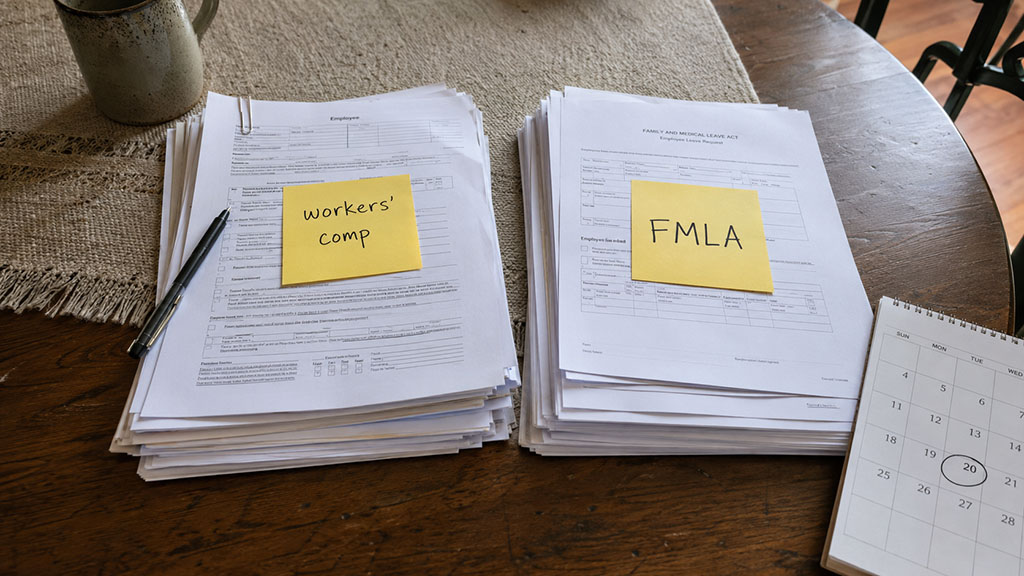
Notice the tradeoff built into that sentence: FMLA protects the job, but it does not pay you. Workers’ comp pays you, but it does not protect the job the same way. Neither one, by itself, gives an injured worker both a paycheck and a guaranteed job waiting at the end of recovery. Getting both benefits means recognizing that they are separate systems that need to be triggered separately, often at the same time, using separate paperwork.
Who Is Not Eligible for FMLA in Delaware
FMLA eligibility is not automatic, and a meaningful number of injured workers do not qualify. Under the Department of Labor’s rules, an employee is eligible only if they have worked for a covered employer for at least 12 months, have logged at least 1,250 hours of service with that employer in the 12 months before the leave starts, and work at a location where the employer has at least 50 employees within 75 miles. A worker who has been at a job for eight months, who works part-time hours below the 1,250-hour threshold, or who works for a small employer with a handful of locations spread out across the state can be denied FMLA protection entirely, even while their workers’ compensation claim is fully valid and paying benefits. That gap is exactly where the myth causes the most damage: workers assume the job protection is automatic because the wage benefits are flowing, and it is not.
Workers’ Comp Pays, FMLA Protects: A Side-by-Side Look
Laid out next to each other, the difference is easier to see and remember.
| Benefit | Delaware Workers’ Compensation | Federal FMLA |
|---|---|---|
| What it pays | 66 2/3% of average weekly wage, plus medical treatment | Nothing, leave is unpaid |
| Job protection | Only protects against retaliation for filing a claim | Guarantees the same or an equivalent job after leave |
| Duration | Indefinite for total disability; up to 300 weeks for partial disability | Up to 12 workweeks in a 12-month period |
| Who qualifies | Nearly all employees injured on the job, regardless of employer size | Employees who meet the 12-month, 1,250-hour, and 50-employee thresholds |
Read that table carefully and one thing stands out: workers’ comp’s wage benefits can outlast FMLA’s 12-week job-protection window by months or years. A worker who needs six months to recover can keep receiving wage-loss checks the entire time under workers’ comp, while FMLA’s job guarantee runs out after 12 weeks, meaning the paycheck and the job-security clock are not running on the same schedule at all.
What Happens When Your FMLA Clock Runs Out Before You Are Cleared to Return
This is where the myth causes the most damage in real cases. An injured worker collecting workers’ comp assumes the job is safe because the checks keep coming, uses up the full 12 weeks of FMLA leave, and is still not medically cleared to return. Once FMLA runs out, the federal job-protection guarantee ends, even though the workers’ compensation claim can continue paying wage-loss benefits for months or years longer. At that point, some employers hold the position open anyway out of goodwill or company policy, and some do not. Delaware law does not require an employer to hold a job open indefinitely simply because a workers’ comp claim remains open. This is exactly the gap the myth hides, and it is worth knowing about before the 12-week clock starts running, not after.
Can Your Employer Actually Fire You While You Are Out on Workers’ Comp?
I’ll give the honest lawyer answer: it depends on why. An employer cannot legally fire you because you filed a workers’ compensation claim, reported a safety violation connected to your injury, or testified in a workers’ comp proceeding. That is retaliation, and Section 2365 makes it unlawful with real financial consequences for the employer. What Delaware law does not prevent, on its own, is an employer eliminating a position for reasons unrelated to the claim itself, such as a broader layoff, a restructuring, or a business decision that would have affected that role regardless of the injury. The difference between the two scenarios often comes down to timing, documentation, and what the employer says or does not say when the termination happens. A termination that lands suspiciously close to a workers’ comp claim, a request for accommodation, or a report of unsafe conditions deserves a closer look before anyone assumes it was simply a coincidence.
What to Do the Day You Are Hurt to Protect Both Your Claim and Your Job
Because these are two separate legal systems, protecting both your paycheck and your position means triggering both at the same time, not assuming one covers the other.

- Report the injury to your employer immediately. This starts your workers’ compensation claim and creates the paper trail that later proves any retaliation claim under Section 2365 if it comes to that.
- Ask specifically about FMLA the same week. Do not wait for your employer to bring it up. Ask HR directly whether you are FMLA-eligible and request the paperwork, since the 12-week clock and the notice requirements around it are easy to miss if nobody raises them early.
- Get your eligibility confirmed in writing. If you do not meet the 12-month, 1,250-hour, or 50-employee threshold, find out now rather than assuming you are covered.
- Keep a written record of every conversation about your job status. Emails and dated notes about what your employer said regarding your position matter enormously if a termination happens later and the timing looks connected to your injury.
- Talk to an attorney before your FMLA leave runs out, not after. Once the 12 weeks are gone, options for protecting the job itself narrow considerably.
If Your Employer Has Fewer Than 50 Employees
Workers at small businesses face this myth the hardest. Delaware workers’ compensation applies to nearly every employer regardless of size, so a worker at a five-person company and a worker at a five-hundred-person company can both receive the same wage-replacement benefits after a job injury. FMLA is different. It generally only covers employers with 50 or more employees within 75 miles of the worksite, which means a meaningful share of small-business employees in Delaware have workers’ comp wage benefits available but no federal job-protection safety net at all. For these workers, whatever job security exists during recovery comes down to individual company policy, direct negotiation with the employer, or the narrower retaliation protection under Section 2365, not a guaranteed legal right to the job itself.
A Note for First Responders Weighing Job Security During Recovery
Police officers, firefighters, and EMS workers face a version of this problem that can be more layered, since some public safety employers have their own leave policies or collective bargaining provisions that go beyond FMLA’s baseline. Those additional protections vary widely from one department or municipality to the next, and they do not replace the need to understand the two separate systems described above. A first responder recovering from a job injury should ask their employer specifically what leave and job-protection policies apply on top of FMLA and workers’ comp, rather than assuming public-sector employment automatically comes with broader guarantees.
FAQs about Workers’ Comp and Job Protection in Delaware
If I am collecting workers’ comp, can my employer replace me while I am out?
In many cases, yes, once FMLA leave (if available) has been exhausted, an employer is not automatically barred from filling the role, as long as the reason is not retaliation for the workers’ comp claim itself.
Do I need to apply for FMLA separately from my workers’ comp claim?
Yes. They are separate legal processes with separate paperwork, separate eligibility rules, and separate deadlines, and one does not automatically trigger the other.
What if I do not qualify for FMLA at all?
Your workers’ compensation wage and medical benefits are not affected by FMLA eligibility, but without FMLA (or a comparable employer policy), the legal guarantee that your specific job is being held open is much weaker.
Can I take FMLA and workers’ comp leave at the same time?
Often yes, and many employers run the two concurrently, meaning your 12 weeks of job-protected leave and your workers’ comp wage benefits can be happening during the same period rather than back to back.
Does filing a workers’ comp claim make me more likely to get fired?
It should not, and doing so is illegal retaliation under Delaware law. In practice, if a termination follows soon after a claim, a report of unsafe conditions, or testimony in a workers’ comp proceeding, that timing is worth having reviewed.
What if my employer never mentioned FMLA to me?
Covered employers generally have notice obligations under FMLA once they become aware of a qualifying need for leave. If you were never told about your rights and later lost your job, that gap in notice is worth raising with an attorney.
Does workers’ comp cover my health insurance while I am out?
Workers’ comp itself does not continue your group health insurance. FMLA does require continued group health coverage during protected leave, which is one more reason the two benefits work better understood together than assumed to overlap.
Talk to a Delaware Attorney Before You Assume Your Job Is Protected
Workers’ comp and FMLA solve two different problems, and assuming one covers the other is how injured workers in Delaware lose jobs they thought were safe. Your workers’ comp claim paperwork, whatever FMLA documents your employer has given you, and a simple timeline of your injury and time off are all the firm needs to spot which protections already apply to you and which ones you still need to request before it is too late. The Law Office of Heather A. Long offers a free consultation to walk through exactly that. Call 302-466-5664 or stop by 501 Main Street, Suite 638, Odessa, DE 19730, and find out where your paycheck protection ends and your job protection needs to pick up.