

Coordinating Workers’ Compensation and PIP Benefits After a Delaware Work-Related Crash
PIP pays a higher percentage of your lost wages, but only for up to two years or until you hit your policy limit. Workers’ compensation pays a smaller percentage, but it can continue far longer and covers medical treatment without the dollar cap that comes with auto insurance. Which one helps you more depends on how long you are out of work and how much treatment you end up needing, which is exactly why the two benefits need to be coordinated instead of picked at random.

If you were hurt in a car accident while doing your job, in Delaware, you are not choosing one benefit over the other. You may be entitled to both, and the order you use them in matters.
Why This Situation Comes Up More Than People Expect
Plenty of jobs put people on the road: delivery drivers, home health aides, sales representatives, contractors driving between job sites, and anyone who runs errands for an employer during the workday. When one of these workers is hit by another vehicle, the crash is both a car accident and a work injury at the same time, which means two separate insurance systems are suddenly involved in the same claim.
Neither insurer is naturally set up to handle that overlap smoothly. The auto insurance adjuster is trained to process a standard car accident claim, and the workers’ compensation adjuster is trained to process a standard on-the-job injury. Neither one automatically loops in the other, which means it usually falls to the injured worker, or the attorney representing them, to make sure both sides know the full picture.
How Fault Affects Each Benefit Differently
One point that catches people off guard is that fault barely matters for either PIP or workers’ compensation. PIP is no-fault by design, meaning it pays regardless of who caused the crash. Workers’ compensation is also generally a no-fault system on the employer’s side, meaning you do not need to prove your employer did anything wrong to receive benefits, only that the injury happened within the course and scope of your job. Fault becomes relevant only if you pursue a separate claim against the other driver, which runs on an entirely different track from either no-fault benefit.
How Delaware PIP Benefits Work
Every vehicle registered in Delaware is required to carry Personal Injury Protection coverage under 21 Del. C. § 2118, with a state minimum of $15,000 per person and $30,000 per accident. PIP pays medical bills regardless of fault and replaces a portion of your lost income, generally around 80% of your after-tax wages, for up to two years from the date of the accident or until the policy limit runs out, whichever comes first. Many drivers carry only the state minimum, and $15,000 does not go far once emergency room care, imaging, and physical therapy are added up.
How Delaware Workers’ Compensation Wage Benefits Work
Workers’ compensation calculates your wage-loss benefit differently. Under 19 Del. C. § 2324, total disability benefits pay 66 2/3% of your average weekly wage, subject to a state maximum and minimum that reset every year. That is a lower percentage than PIP’s 80%, but the tradeoff is duration. Total disability benefits can continue for as long as you remain unable to work, and even partial disability benefits, paid when you can work but at a lower earning capacity, run for up to 300 weeks. Workers’ comp also pays for reasonable and necessary medical treatment connected to the injury without the flat dollar cap that PIP carries.
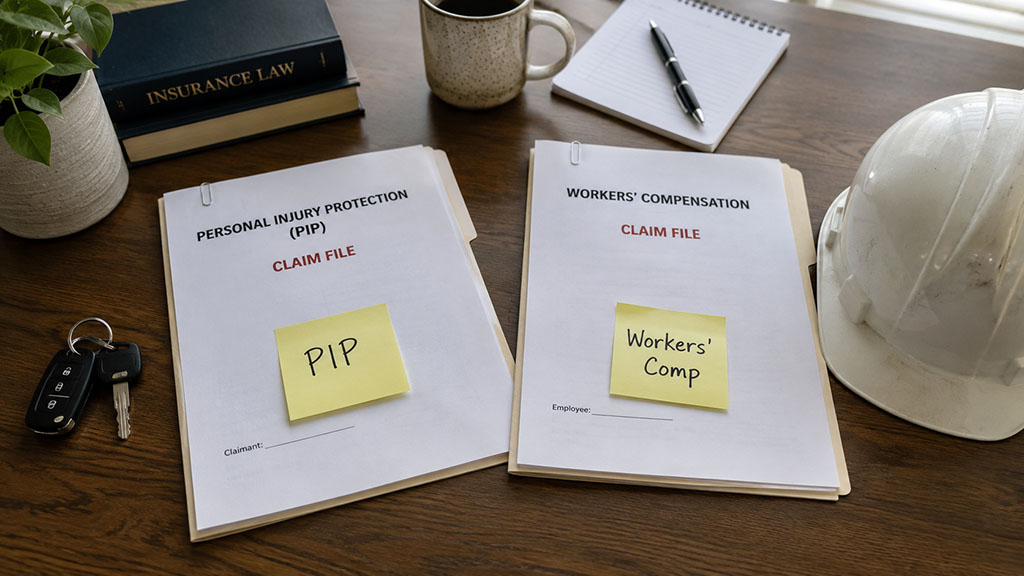
PIP Pays More Per Week, Workers’ Comp Pays Longer
Laid out side by side, the tradeoff becomes clear.
| Benefit | PIP (Auto Insurance) | Workers’ Compensation |
|---|---|---|
| Wage replacement rate | About 80% of after-tax wages | 66 2/3% of average weekly wage |
| Maximum duration | 2 years from the accident date | Indefinite for total disability; up to 300 weeks for partial disability |
| Dollar limit | Policy limit, often $15,000 state minimum | No flat dollar cap on related medical treatment |
| Fault requirement | None, pays regardless of fault | None, pays regardless of fault |
Neither benefit is automatically the better choice, and the right answer often only becomes clear once treatment has progressed far enough to see the real recovery timeline. Someone who returns to work within a few months may come out ahead using PIP for its higher weekly rate. Someone facing surgery and a long recovery is usually better served by workers’ compensation, since PIP’s two-year clock and policy limit run out long before an extended claim resolves.
The Biggest Mistake: Running Every Bill Through PIP First
The most common error in these cases is straightforward: the injured worker lets the auto insurance carrier pay every medical bill from day one, without realizing that a work-related crash also opens a workers’ compensation claim. Workers’ compensation pays for an unlimited amount of medical treatment as long as it is reasonable, necessary, related to the injury, and performed by a certified provider. PIP benefits, once used up, are gone. A worker who burns through a $15,000 PIP limit on emergency care and early treatment can find there is nothing left for the wage-loss payments that would have helped cover rent and a car payment during recovery.
Coordinating both claims from the start, rather than defaulting to whichever insurer calls first, keeps the higher-limit, longer-duration workers’ compensation benefit available for when it is needed most.
What Documentation Both Claims Actually Need
Filing both claims correctly means keeping records that most people do not think to organize after a crash. A first report of injury filed with your employer establishes the work-related side of the claim, while your auto insurance company separately needs the police report and vehicle damage information. Keep every medical bill and explanation of benefits from both sides, since figuring out later which insurer already paid which bill is far harder than tracking it from the start. Wage records matter too, since both PIP’s 80% calculation and workers’ compensation’s 66 2/3% calculation depend on an accurate picture of what you were earning before the crash.
Which Benefit Should You File First
There is no single answer that fits every case, but a few factors point the decision in one direction or the other.
- Expected time off work. A short recovery may favor PIP’s higher wage-replacement percentage. A longer one favors workers’ compensation’s lack of a hard time limit.
- Size of your PIP policy. A $15,000 state-minimum policy disappears quickly against hospital charges. A larger policy gives more room before workers’ comp needs to take over.
- Whether surgery is likely. Surgical treatment and the recovery that follows can outlast a two-year PIP window entirely.
- Who is paying what right now. If bills are already being split between two insurers without a clear plan, that is a sign to get the coordination sorted out before it causes a gap in coverage.
- Whether you have already returned to work in some capacity. Light-duty or reduced-hours work changes which partial-disability calculation applies and can shift which benefit makes more sense going forward.
What Happens If Both Insurers Point Fingers at Each Other
It is common for a PIP carrier and a workers’ compensation insurer to each argue that the other should be paying, especially early in a claim before fault or work-relatedness has been sorted out. Each side has a financial incentive to shift the cost onto the other insurer, and an injured worker caught in the middle rarely has the leverage to resolve that argument alone. While that argument plays out, medical bills can sit unpaid and reach collections, and wage-loss payments can be delayed. Delaware law does not require an injured worker to referee that dispute alone. An attorney who handles both sides of these claims can push each carrier to meet its obligations while the coordination question gets resolved, instead of leaving the bills and the missed paychecks to sort themselves out.

What This Means If You Are Also Suing the At-Fault Driver
A work-related car accident caused by another driver can also lead to a separate injury claim against that driver, on top of both PIP and workers’ compensation. That third layer has its own rules about what a workers’ compensation insurer can recover back from any settlement or verdict against the at-fault driver. If you are dealing with a driver who was underinsured or uninsured on top of the workers’ compensation question, all three pieces need to be coordinated together, not handled as three unrelated claims.
What Happens to Unused PIP Benefits If You Recover Quickly
If you return to work well within the two-year PIP window and your policy limit was never exhausted, the remaining PIP benefit does not simply disappear, but it also does not transfer into extra workers’ compensation money. Each benefit only pays for what it was designed to cover. A quick recovery mostly means the coordination question resolves itself before it ever became complicated, since PIP handled the bulk of the claim and workers’ compensation never needed to take over the larger share.
Why the Employer’s Role Still Matters Even With Auto Insurance Involved
Some injured workers assume that because a car accident involves auto insurance, their employer and its workers’ compensation carrier are not part of the conversation. That assumption can cost real money. Reporting the crash to your employer as a work injury, on top of reporting it to the auto insurer, is what preserves your right to the workers’ compensation side of the claim at all. Skipping that step because the accident already feels like a straightforward car accident case is one of the more common ways injured workers lose access to the longer-lasting benefit.
FAQs about Workers’ Comp and PIP After a Delaware Work Accident
Can I collect both PIP and workers’ compensation for the same car accident?
Yes, in many cases both apply, though the specific coordination depends on which bills and wage-loss periods each insurer is responsible for. The goal is to sequence them correctly, not to pick only one.
Do I have to use my own auto insurance if the accident happened at work?
PIP is typically the first payer for initial medical treatment under Delaware’s no-fault system, but that does not mean you should let it absorb every bill without also opening a workers’ compensation claim for the work-related injury.
What if my employer says the accident does not count because I was driving my own car?
Whether a car accident is covered by workers’ compensation usually depends on whether you were acting within the course and scope of your job duties at the time, not on whose vehicle you were driving. Running an errand for your employer or traveling between job sites can qualify even in a personal vehicle.
Does using PIP first affect my workers’ compensation claim later?
It can complicate reimbursement between the two insurers if it is not tracked correctly from the start, but it does not automatically disqualify you from workers’ compensation benefits.
What if my PIP benefits run out before I can return to work?
If the injury is also work-related, workers’ compensation wage-loss benefits can continue past the point where PIP’s two-year limit or policy cap ends, provided the workers’ compensation claim has been properly filed and documented.
Can I also sue the driver who hit me if the accident happened while I was working?
Often yes, especially if the other driver was at fault, on top of your workers’ compensation and PIP benefits. That claim runs on a separate track with its own rules about reimbursing the workers’ compensation carrier out of any recovery.
Does my employer’s workers’ compensation insurance go up if I file a claim for a car accident?
Delaware law prohibits employers from firing an injured worker simply for filing a workers’ compensation claim, and premium concerns on the employer’s side are not a valid reason to deny or discourage a legitimate claim tied to a work-related crash.
What if the accident happened during my commute to work?
Ordinary commuting to and from a fixed workplace generally is not covered by workers’ compensation, even though PIP would still apply to the crash itself. Accidents that happen while traveling between job sites, running errands for the employer, or driving as part of the job itself are treated differently and often do qualify.
Talk to a Delaware Attorney Before Choosing Which Benefit to File
A work-related car accident touches PIP, workers’ compensation, and sometimes a separate injury claim against another driver, all at the same time. The Law Office of Heather A. Long coordinates all three from the start, so bills get paid, wage-loss checks keep coming, and no benefit gets used up before it needs to be. Call 302-466-5664 or visit 501 Main Street, Suite 638, Odessa, DE 19730 for a free consultation on your work-related car accident claim. Bring your accident report, any correspondence from either insurance company, and a record of your lost time from work, so the firm can map out exactly how your PIP and workers’ compensation benefits should work together from the start rather than after a gap in coverage has already cost you money.